

Get 25 battle-tested prompts
Turn real client conversations into Linkedin content that builds authority and attracts the right clients.
Turn real client conversations into Linkedin content that builds authority and attracts the right clients.
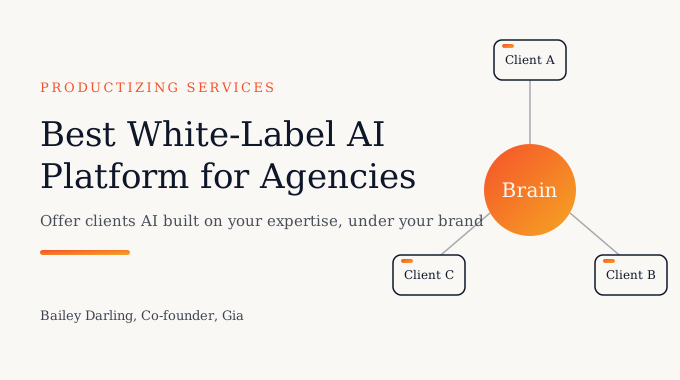
The best white-label AI platform for an agency depends on what you want to sell under your brand. If you want to hand each client a private AI built on your agency's own expertise, Gia (getgia.ai) is built for that: it turns your playbooks, calls and Slack history into one company brain, then gives each client their own white-labeled copy in Slack, Microsoft Teams, the browser, or their own ChatGPT or Claude. If you want to resell website chatbots or voice agents to your clients' customers, Stammer AI and Chatbase are stronger fits.
Most 'white-label AI' lists mix two different businesses together. One is reselling a chatbot that sits on a client's website and answers their customers. The other is handing the client your agency's thinking, so their team can ask your frameworks a question at 9pm on a Sunday without waiting for your next call. Both are legitimate. They just need different software.
I talk to agency owners about this every week, and the question usually shows up as 'can I put my name on it?' The honest answer is that almost every platform below can hide its own logo. What changes from tool to tool is who the AI is for, what it knows, and where your client actually uses it.
Here is the short list for agency owners who want to offer AI to clients under their own brand:
A white-label AI platform lets you deliver an AI product to clients with your brand on it and the vendor's brand hidden. In practice that covers a few separate things, and vendors use the word for all of them:
Before you sign anything, ask which of these four you're actually getting. A badge removal is useful, but it isn't the same as a product you can package and sell.
Every tool below is described from its own website as of November 2026. Where a vendor doesn't publish something, I've written 'not listed.'
Sources: Stammer AI, Chatbase pricing, CustomGPT.ai pricing, DocsBot pricing and Pickaxe pricing.
Gia is a company brain for agencies and consulting firms that they deploy to their own clients, white-labeled, through Slack, Microsoft Teams, browser or MCP.
Other tools build an internal knowledge base or a public chatbot. Gia builds a private brain the firm hands to its clients as a paid product. It connects to the places your expertise already lives, like your Drive, Slack, call recordings and CRM, and learns how your team actually makes decisions. Then you spin up a separate workspace for each client that combines your frameworks with that client's own context.
The part agency owners tend to care about most is where the client uses it. I've watched plenty of agencies build a client portal that nobody logs into. So Gia meets clients in the tools they already open every day: a bot in the shared Slack channel, an app in Teams, a browser extension, or an MCP connection inside the ChatGPT or Claude account they already pay for.
On the white-label side, I tell agencies not to introduce it as Gia at all. Present it as your agency's own AI, built on your years of client work. Each client's workspace is isolated from the others, Gia is SOC 2 Type II, client data isn't used to train models, and setup takes about a day. If you want to sell it, you can charge clients through Stripe.
Best for: agency owners who want to sell access to their expertise as a product alongside their retainers.
Less suited to: a public chatbot answering a client's website visitors. Use Stammer AI or Chatbase for that.
Stammer AI says it was built 'helping agencies resell AI chatbots and voice agents under their own brand.' The white-label is thorough: custom domain, your logo and colors, and client dashboards that show calls, chats, leads and bookings. Its homepage puts it plainly: 'Clients never see Stammer, only YOUR company.'
Agents run on websites, social messaging and phone lines, handling lead capture, customer questions and appointment booking. If your agency sells AI receptionists or lead-qualification bots to local businesses, this is purpose built for you.
Best for: agencies whose offer is an AI agent that talks to their clients' customers.
Chatbase is one of the best-known AI support agent builders, with a long list of channels and integrations, including WhatsApp, Slack, Zendesk, Salesforce and HubSpot. For agencies, the white-label story is lighter: a $99 per month add-on removes Chatbase branding from deployed agents, and 'White-labeling' appears on the Enterprise plan. Chatbase's own comparison article recommends it for agencies whose main product is managed AI customer support rather than a branded software portal.
Best for: agencies running support automation as a service.
CustomGPT.ai builds agents grounded in a company's documents and websites, with Slack deployment on every plan. Removing the 'Powered by CustomGPT.ai' branding requires the Premium or Enterprise plan. It's a good choice when the client has a large body of content and needs a chatbot that cites it.
Best for: content-heavy clients who need accurate, sourced answers.
DocsBot turns documentation into support bots, with an unusually wide set of channels, including Slack, WhatsApp, Telegram and an MCP server on higher plans. Unbranded widgets and per-bot roles for reselling sit on the Business plan. It doesn't list a custom domain or agency dashboard.
Best for: agencies supporting SaaS or product clients with help-center bots.
Pickaxe lets you build AI tools and package them into Studios, which are standalone web apps you can host on a custom domain and charge subscriptions for. White-labeling is listed on every paid plan. It's flexible and quick, though each tool is something you design and maintain by hand.
Best for: agencies that want to sell a handful of AI tools to the public or to clients.
A lot of owners start here, and it makes sense: ChatGPT and Claude are already in the client's hands. The catch is that custom GPTs and Claude Projects live inside OpenAI's and Anthropic's interfaces with their names on them, you can't bill clients for access through them, and keeping a separate, private version for each client becomes manual work fast. I wrote up the full comparison in our guide to custom GPT alternatives for agencies.
MCP changes this a bit. With an MCP connection, your agency's brain can show up inside the client's own ChatGPT or Claude, while the knowledge, the access controls and the client relationship stay with you. If that's new to you, our explainer on MCP for agencies covers the basics.
Four questions sort most agencies into the right tool:
One more thing I always say on calls: start internally. Put the brain in your own team's Slack first, fix what it gets wrong, then roll it out to one client who asks a lot of questions between meetings. That client becomes your proof before you package it for everyone. Our guide on how to productize agency services walks through the packaging side, and our roundup of company brain software for agencies compares the internal options.
It shouldn't, and I'd steer you away from any pitch that frames it that way. The agencies I work with use a client-facing brain for the questions that don't need a meeting: how do we apply your framework to this campaign, what did we decide last quarter, does this draft match the strategy. Their people stay on strategy and judgment. Clients get faster answers between calls, and your team spends less time repeating itself.
For an agency that wants to give clients a private AI built on its own expertise, Gia is designed for that: one company brain with a white-labeled workspace per client in Slack, Microsoft Teams, the browser or MCP. For reselling website chatbots or voice agents, Stammer AI is the most agency-focused option.
Not directly. Custom GPTs stay inside ChatGPT under OpenAI's brand. You can, however, connect your agency's own AI to a client's ChatGPT or Claude through MCP, so they get your expertise inside the assistant they already use while you keep control of the knowledge and access.
Published prices vary widely. As of November 2026, Stammer AI's white-label plan is $99 per month, Chatbase charges $99 per month to remove its branding on top of a paid plan, CustomGPT.ai's Premium plan is $499 per month, and DocsBot's Business plan is $499 per month. Gia shares pricing on a demo.
Yes. Many agencies sell it as a monthly subscription next to their retainer or as an ongoing service after a project ends. Gia supports charging clients through Stripe, and each client's workspace stays separate.
It depends on the platform's controls. Look for per-client isolation, a clear policy that client data isn't used for model training, and a security audit such as SOC 2 Type II. Gia has all three, and you choose what each client's brain can see.
A white-label chatbot answers a business's customers from its website and help content. A company brain captures how your agency thinks and works, then gives your clients access to that expertise in their own tools.
We're already working with a few marketing agencies that hand their clients a private brain built on their own playbooks. If you want to offer AI to clients under your brand without building it yourself, book a 30-minute demo and we'll walk through it using your own material.


