

Get 25 battle-tested prompts
Turn real client conversations into Linkedin content that builds authority and attracts the right clients.
Turn real client conversations into Linkedin content that builds authority and attracts the right clients.
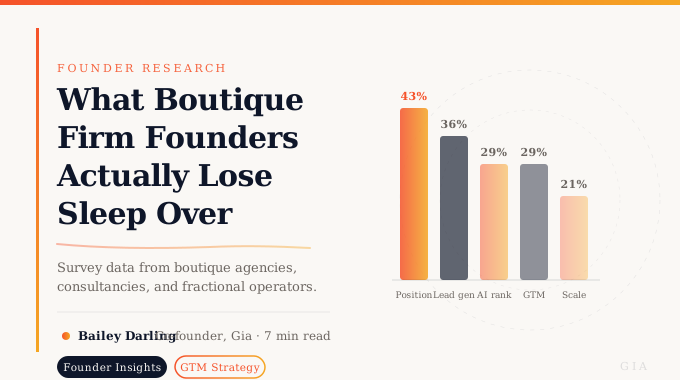
We surveyed founders of professional service firms -- boutique consultancies, agencies, fractionals -- with one simple question: "What would you love to pick someone's brain about?"
I expected a range of answers. Operations. Team structure. Client delivery. Maybe hiring.
Instead, 43% pointed to the same thing: how they show up in the market. Positioning, pricing, and packaging their offer. The rest of the top five? Lead gen and top of funnel (36%), AI and LLM ranking (29%), GTM strategy and growth (29%), and scaling and productizing their services (21%).
These aren't soft, aspirational topics. Every one of them is something founders lose sleep over. And after speaking with dozens of consultants and agency owners over the past year, I can tell you -- the patterns are real, and the stakes are high. Founders who figure out these five areas first will operate with an advantage that compounds over the next 18 months. The ones who don't will wonder where their referrals went.
Let me walk through each one and what I'm actually seeing on the ground.
This was the runaway leader, and the reason makes sense once you sit with it.
Most professional service founders are exceptional at their craft. They are not, by default, great at explaining what they do in a way that makes buyers say, "That's exactly what I need." The positioning problem is almost never about capability -- it's about translation.
When I spoke with a pricing strategy expert about Gia's own packaging challenges, one point stuck with me: "Always try to position around their outcome. You can't claim that you can give them that outcome, but you can claim that you can help them make progress on getting that outcome." That framing changed how I thought about our own messaging.
The data backs this up as a broad industry problem. In the 2025 SPI Professional Services Maturity Benchmark, EBITDA margins fell to a five-year low of 9.8%, down from 15.4% the year before. Part of that is a cost problem. But a lot of it is a value communication problem -- firms delivering real outcomes but failing to price and position themselves accordingly.
The packaging trap most founders fall into: they describe what they do (the deliverable) instead of what changes for the client (the outcome). A six-week strategy engagement sounds like a cost. "Build a clear path from $500K to $2M in recurring revenue" sounds like an investment.
If you're getting price-shopped, that's almost always a positioning signal -- not a market signal.
Here's something I've heard in some version across nearly every discovery call with a consultant: "I know I should be doing more outbound. I'm just not doing it."
The honest version of why, which one founder put plainly, was: "Do I have an outbound strategy? Yes. Do I actually do it? No."
That's not laziness. It's a combination of psychology and structure. Most consultants didn't come from a sales background. Cold outreach feels transactional in a business that runs on trust. And when client work picks up, pipeline generation is the first thing to drop -- because it has no external deadline.
The consultants I've seen crack this aren't doing more outbound. They're getting better at making their existing conversations work harder. One GTM consultant I spoke with had built her entire pipeline through associations, accelerators, and incubators -- not cold email. She avoided the feast-and-famine cycle by systematically staying close to ecosystems where her buyers already gathered. Another firm owner was converting warm intros at a dramatically higher rate simply by following up with structure -- not persistence.
The top-of-funnel problem for most boutique firms is less about volume and more about consistency and relevance. Building a pipeline that doesn't evaporate when you get busy is the real challenge.
This one surprised me -- not that founders flagged it, but how many flagged it without having a clear plan.
Nearly 3 in 10 founders said they'd love to pick someone's brain about AI and LLM ranking. That's a signal worth paying attention to. A year ago, this category didn't exist in conversations like this.
Here's what's happening: buyers are changing where they start their research. When someone needs a GTM consultant or a management consulting firm, a growing number of them aren't starting on Google. They're opening ChatGPT or Perplexity and asking a direct question. And the firms that show up in those answers are not necessarily the ones with the best SEO. They're the ones with the most substantive, citable content -- the ones that AI systems recognize as authoritative sources.
The numbers are striking. Webflow reports that 8% of their signups now come from LLM traffic, and that traffic converts at 6x the rate of traditional Google Search. Contently For B2B professional services -- where trust drives everything -- the conversion premium could be even higher. AI referral traffic grew 527% year-over-year between early 2024 and early 2025, and ChatGPT referrals convert at 15.9% compared to Google organic's 1.76% -- a roughly 9x difference. Virayo
This is what I mean when I say AI ranking is becoming the new SEO. The game is not gone -- it's changed. And for boutique consulting firms that compete on authority and specificity, this is actually an opportunity. The firms with the most differentiated point of view, clearly articulated across multiple channels, are the ones AI systems will keep surfacing.
Most founders know this matters. Very few have a plan.
Ask ten consulting firm founders to define their go-to-market strategy and you'll get ten different versions of the same answer: "Referrals, mostly."
Referrals are real and valuable. They close faster, require less trust-building, and often bring in the best clients. But referrals are not a strategy -- they're an outcome. You can influence them, but you can't control them. And when they slow down, you're exposed.
What I see consistently with boutique firms is that their GTM strategy is implicit, not explicit. They know what has worked before. They haven't written it down, tested it, or built it into a repeatable system.
A growing body of research shows that B2B buyers increasingly prefer digital-first interactions before engaging a human advisor. That means your firm's digital presence -- what shows up when someone searches for you, what they find on LinkedIn, what your existing clients say about you in communities -- is doing GTM work whether you're managing it or not.
The founders who are figuring this out are being intentional about their ecosystem. They're picking one or two communities where their ICP spends time and showing up consistently. They're treating every client conversation as a source of insight that can become content. They're building what might look like a loose brand strategy but is really just structured relationship development at scale.
The difference between a firm with a GTM strategy and one without isn't always visible in year one. By year two, it's hard to miss.
The typical arc for a boutique consulting firm goes something like this: win clients through expertise and relationships, deliver custom engagements, grow revenue through more hours, hit a ceiling because you can only do so much custom work.
Productizing breaks that ceiling. It means taking the thing you do repeatedly -- the assessment, the workshop, the 90-day engagement -- and packaging it in a way that's easier to sell, deliver, and scale.
The appeal is obvious. The execution is hard.
What I hear most from founders exploring productization is that they're worried about commoditizing their work. If they put it in a box, does it become a commodity? The anxiety is understandable. But the opposite risk is real too -- staying fully custom keeps you out of conversations where buyers want a defined scope and a clear deliverable.
One consultant I spoke with had effectively solved this by building tiers. The productized offer at the entry level got people in the door. The custom engagement came after, once trust was established. Her close rate on custom work improved because prospects had already experienced her thinking through the productized offer first.
Scaling productized services also has a practical AI tailwind. The professional services market is projected to reach $2.47 trillion by 2032, growing at an 11.4% CAGR. Research And Markets Firms that have standardized delivery models will be best positioned to use AI to operate at higher volume without linear increases in headcount.
What stands out about this survey isn't any single finding -- it's what these five areas have in common.
Positioning, lead gen, AI ranking, GTM, and productizing are all about market presence. They're not about doing better work. Every consultant who makes it to the point of running a firm is already good at the work. The ones who grow are the ones who get as serious about how they're perceived and discovered as they are about delivery.
The next 18 months will be consequential for boutique professional service firms. AI is reshaping how buyers discover, evaluate, and select advisors. The market is large and growing, but so is the number of firms competing for attention within it.
Founders who treat these five questions as urgent -- not interesting someday problems -- will be the ones who build something durable.
What's on your list?


