

Get 25 battle-tested prompts
Turn real client conversations into Linkedin content that builds authority and attracts the right clients.
Turn real client conversations into Linkedin content that builds authority and attracts the right clients.
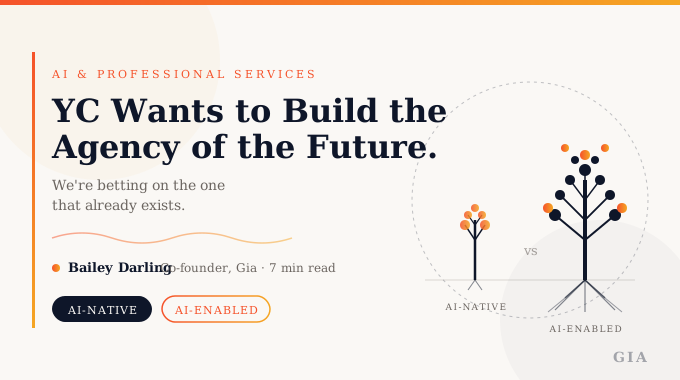
Y Combinator's Spring 2026 Request for Startups is calling for founders to build AI-native agencies. Their thesis: the traditional agency model is broken. Low margins, headcount-dependent scaling, slow manual work. AI changes all of that, and the firms built from scratch around AI will capture the margin and the market.
They're not wrong about the problem. But I think they're wrong about who solves it. The AI-native vs AI-enabled agency debate isn't actually about which model wins — it's about which one has a path to defensibility. And once you look at it that way, the math gets a lot more interesting.
The YC argument is clean: instead of selling software to clients so they can do the work, build a firm that uses the software itself and sells the finished output. A design firm that delivers five polished concepts before a contract is even signed. An ad agency that cuts video production time from weeks to days. A law firm that drafts in minutes instead of weeks.
These firms, the theory goes, will scale like software companies with software margins. And they'll disrupt the fragmented professional services markets that have operated on people-hours economics for decades. Sequoia partner Julien Bek has made the same case, arguing in Fortune that the next trillion-dollar company won't sell software at all — it'll sell an outcome delivered by AI-native services.
It's a compelling case. And it's already playing out in pockets. One YC-backed accounting firm I spoke with recently moved from the industry standard of 20 accounts per accountant to 120 to 150 per accountant by embedding AI into the backend of an acquired CPG-focused firm. Their target gross margin: 70%. That's software territory.
So yes, AI-native agencies are real, they're fundable, and some of them will be very large businesses. But here's what the "build from scratch" framing misses.
Over the past year, I've had more than 500 conversations with founders, consultants, and agency owners. And almost none of them are sitting around waiting to be disrupted.
A crisis communications firm I talked with recently has spent years building narrative architecture for C-suite executives in some of the most high-stakes situations imaginable. A boutique branding agency I met with manages 10 to 12 clients at a time, with a methodology refined over years of working with early-stage startups from MVP to Series A. A leadership consulting firm I spoke with built a proprietary 360-degree assessment that took years to validate and now powers 18 to 24 month organizational transformation engagements.
None of this was built from scratch in a YC batch.
The value these firms provide is the methodology, the track record, and the trust. A client doesn't just hire a crisis communications firm; they hire the judgment forged through hundreds of past crises. That's not something a new, AI-native agency replicates by spinning up in six months.
What these firms need isn't replacement. It's the ability to operate at a different speed.
The AI-native vs AI-enabled agency distinction matters here because most of the boutique firms I talk to don't fall neatly into either bucket — they're somewhere in the middle, and figuring out where they want to land is the strategic question.
One founder I spoke with runs a five-person agency. She's building websites in minutes now, using AI to handle execution while keeping her creative process and methodology entirely intact. Her philosophy: an agency has to have its own approach first, then use AI to execute it faster and more reliably. She also believes she can pay her existing team significantly more because AI keeps overhead low while increasing output.
That's not disruption. That's evolution.
Another operator I met, a consultant who had stepped back from his business for nine months due to health issues, is now rebuilding from scratch in a market that shifted dramatically under him. He described AI as "disintermediating everything, forcing everybody to redefine how they are structuring their offerings." He wasn't lamenting it. He was adapting.
A management consultant I spoke with raised the framing I find most useful: consulting work splits cleanly into "judgment tasks" (strategic insight, creative direction, relationship management) and "intelligence tasks" (data collection, stakeholder interviews, proposal-to-project-plan translation, deadline management). The intelligence tasks are exactly what AI should be handling. The judgment tasks are exactly what the best legacy firms are known for.
When you separate those two categories and let AI take the intelligence work, a five-person firm can deliver what used to require ten people. A solo consultant can maintain client relationships that would have previously required an account team.
Adoption among existing firms is moving faster than most people realize. 62% of consulting firms have adopted AI globally, and 59% are integrating generative AI for predictive modeling, workflow automation, and strategy development. McKinsey's internal AI tool, Lilli, is now used monthly by more than 75% of the firm's 43,000 employees, with the firm reporting that AI agents now work alongside human consultants on actual client engagements. These are not startups. These are established firms adapting in real time.
And among boutique professional services firms, the adoption story is similar: they're moving, many of them faster than their clients expect. One agency founder I talked with has already restructured her pricing model around AI-enabled delivery. Another rebuilt his entire content workflow around his proprietary IP, using call transcripts and client conversations as the raw material so nothing he produces reads like generic output.
The challenge for these firms isn't awareness. It's time and infrastructure. They're running on 10 to 14 stitched-together tools, managing client delivery manually, and trying to maintain a content presence on LinkedIn while simultaneously delivering client work. One operator told me that manually connecting with leads and managing outbound campaigns was costing him four hours a week. Another said that translating a sales proposal into a project plan in their project management tool was a multi-hour exercise every time.
These are not strategic failures. They're operational gaps that AI can close — if the AI is built for how service firms actually work.
YC is funding founders to build new agencies from scratch with AI baked in. That's a legitimate bet, and some of those companies will be excellent.
We're making a different bet: that the thousands of boutique service firms already doing excellent work for real clients are the ones worth building for. That their institutional knowledge, client trust, and methodological depth represent competitive advantages that new entrants can't replicate from a blank slate.
That's where Gia is today. We're building the AI infrastructure that lets a five-person agency operate like a ten-person one, lets a solo consultant maintain relationships that used to require a team, and lets a boutique firm produce the thought leadership and client delivery that used to require a content marketer, a project manager, and a business development rep.
AI-native agencies will win some markets. Probably the ones where trust and methodology matter less and speed and volume matter more.
But for the markets where relationships are everything, where a firm's reputation was built over years of client results, and where judgment is the product? Those firms aren't going anywhere. They just need better infrastructure.
And that's exactly the gap we're building to close.
Gia is a growth platform built specifically for boutique professional service firms. If you're a consultant or agency owner thinking about where AI fits into your practice, I'd love to hear from you.


