

Get 25 battle-tested prompts
Turn real client conversations into Linkedin content that builds authority and attracts the right clients.
Turn real client conversations into Linkedin content that builds authority and attracts the right clients.
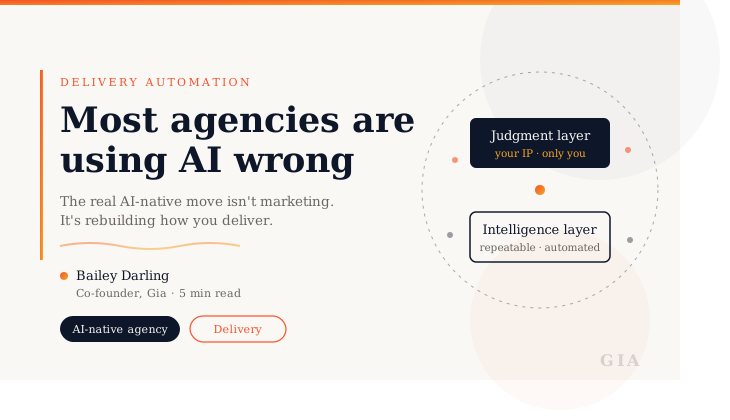
Everyone's building AI features. The ones that will actually scale are rebuilding their entire delivery around it.
I've talked to over 500 founders and agency operators in the last year. The pattern is consistent: they're using AI to get more leads, write better copy, and automate outbound. And then they hit a wall.
They win the meeting. But they can't scale the work.
One founder with a five-person boutique agency described it perfectly. She's spending 70% of her time in client delivery, and it's killing her ability to sell. If revenue doubled tomorrow, her biggest fear is that she'd physically can't be in every room. Quality breaks down. Scope creep seeps in through the gaps she can't cover. She's already maxed out on hours.
That's the scenario AI-native actually solves. Not marketing. Delivery.
The YC thesis from Summer 2026 is right about one thing: when the software does the work, the buyer pays for the work. But this isn't a SaaS story. It's a services story.
The problem is that most agencies are treating AI like a marketing tool. They're tacking it onto their pitch, their email sequences, their social media. That's useful, sure. But it doesn't fundamentally change what breaks under scale.
A marketing agency founder I spoke with had tripled his team size trying to keep pace with demand. His account managers were still spending 30 to 35 minutes per week writing client status updates. Across a dozen accounts, that's a dozen hours of admin work that should take minutes. When you're managing millions of dollars in client spend, that time adds up fast. One day of automation somewhere becomes 25 to 30% more capacity without hiring.
But none of that shows up in your pitch deck. It doesn't look like progress if nobody outside your team sees it.
There's a framework that separates what matters: divide all your client work into two buckets.
The Judgment Layer is the work only you can do. Your actual IP. Strategic insight, client taste, the decisions that require your particular brain. The work clients hired you for. Nobody should automate this. The second you try, you've lost your value.
The Intelligence Layer is everything else. It's objective, repeatable, binary tasks. Translating a client proposal into a detailed project plan with all dependencies mapped. Updating deadlines across fifty tasks when a client goes on vacation. Building status reports from raw data. Extracting the story from a client's interview transcripts. Scheduling stakeholder calls. Running the same audit on a client's existing system for the third time this month.
Right now, agency founders and consultants spend premium hours on intelligence-layer work. They do it because they're the fastest, or because they don't trust anyone else to get it right. But every hour there is an hour not spent in the judgment layer, where their real value lives. Research suggests generative AI could free up workers' time by roughly 30%, and for service firms that capacity belongs in the judgment layer.
I audited a Reddit marketing agency's full delivery workflow. Out of 150 identified tasks, 111 of them were intelligence-layer candidates for automation. They were spending four days a week on administrative overhead that could be moved into an AI system. The result: their manual reporting time dropped from 100+ hours a month to 10.
That's the actual AI-native move. Not content features. Delivery infrastructure.
Sales teams have always been able to say "our market is crowded" and still survive. Everyone does lead generation differently. Everyone has a slightly different pitch.
Client delivery can't survive being commoditized. It has an SLA. If you miss a deadline, the client relationship breaks. If scope creep goes unchecked, your margin gets eaten. If the handoff from sales to delivery is sloppy, the client feels it immediately.
That's why agencies will pay for tools that touch delivery. They won't pay for another LinkedIn posting algorithm. But they will pay to automate the fourteen tasks that sit between a signed contract and the first deliverable.
A lead generation agency handling 150 requests for proposals per month can't manually check every job title filter, every account suppression list, every naming convention that needs to align across Salesforce, operations, and billing. You're guaranteed to have errors. You're guaranteed to miss something. AI doesn't get tired of checking the same list twice.
An account manager at a media buying firm doesn't want another dashboard. But she would use a tool that gave her a morning digest of recommended optimizations, flagged the ones she should approve, and automatically ran the approved changes. That's not automation for automation's sake. That's removing the thing between her and forward-looking strategy.
Here's the uncomfortable part: every firm that figures this out now gets a year, maybe two, before it becomes table stakes.
The new startups in the YC batch will eventually solve the delivery problem. They'll start lean, with high margins, and great tech. But they'll start with zero clients and zero trust. They're months away from figuring out what practitioners actually need because they're still trying to land the first deal.
The firms that already have clients, already have processes, already have margin structure, have a different advantage: they can rebuild from the inside.
If you already have fifty clients paying you for outcome-based work, and you rebuild your delivery layer to be 50% more efficient through AI, you just increased your baseline margin. That's not a new feature to sell. That's a fundamental shift in unit economics.
That's the AI-native move that sticks.
The conversation around AI and professional services has been stuck on the same story for two years: smarter marketing, better pitches, more personalized outreach. That conversation is tired.
The real question is whether your delivery engine can actually scale. Not your sales funnel. Not your content calendar. Your ability to execute the same high-quality work for fifty clients that you currently do for five, without burning out, without cutting corners, without losing margin.
That's where AI-native actually matters. And it's where the firms that already exist have the unfair advantage.


