

Get 25 battle-tested prompts
Turn real client conversations into Linkedin content that builds authority and attracts the right clients.
Turn real client conversations into Linkedin content that builds authority and attracts the right clients.
Most conversations about AI in professional services focus on the front end: generating leads, writing proposals, posting content. That's where the obvious wins are, and it's where most tools are being built.
But there's a different conversation worth having, one that goes further into the business and addresses a more fundamental problem. It's about what happens after you win the client. It's about delivery.
Specifically, it's about the fact that not all delivery work is created equal, and most firms are treating it like it is.
Every client engagement contains two distinct categories of work, and they require completely different things from the people doing them.
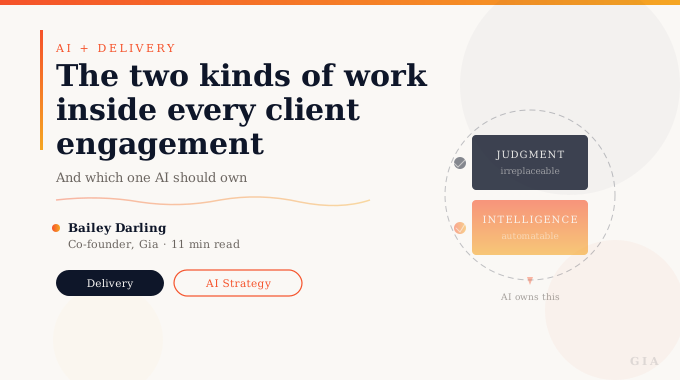
The first is what we call the judgment layer. This is the work only you can do. The strategic recommendation that reframes a client's problem. The creative direction that reflects years of pattern recognition. The relationship insight that knows when to push and when to hold back. Clients are paying a premium for this layer. It cannot and should not be automated, and any AI tool claiming otherwise is overselling.
The second is the intelligence layer. This is the objective, repeatable work that sits between you and the client. Stakeholder interviews, data gathering, briefing documents, scope verification, project plan creation, status updates, timeline management. This work is necessary. It matters. But it doesn't require your expertise to execute.
The problem is that most firms staff for both layers the same way: with senior people's time. And that's where the margin starts to quietly erode.
Across dozens of discovery conversations with agency founders and consultants, a few numbers keep coming up.
Consultants spend roughly 40% of their delivery time on intelligence layer tasks, specifically data collection and documentation work that is objective and repeatable. For a five-person agency running 10 to 12 clients simultaneously, that's a significant portion of total capacity tied up in work that, by definition, doesn't require the expertise clients are paying for.
The cost shows up in a few ways.
One founder described the manual process of translating a sales proposal into a detailed project plan in Asana, complete with tasks, subtasks, and dependencies. The kind of work where a single client going on vacation cascades into hours of manual deadline adjustments across the entire project. Not strategic work. Not the work clients are paying for. Just coordination that has to happen.
Another consultant shared that they're paying $7,000 per project for external researchers to run stakeholder interviews during the discovery phase. Their clients are already pushing back on the cost. The consultant has no clean solution: hire more people and margins compress; keep the process as-is and growth stalls. The intelligence layer work is the constraint.
The scope creep problem compounds this. According to Ignition's 2025 research, 57% of agencies lose $1,000 to $5,000 per month to unbilled scope creep, with 30% losing more than $5,000 monthly. Only 1% of firms successfully bill for all out-of-scope work. A significant share of that creep happens not because clients are bad actors, but because no one on the delivery team had instant access to what was actually agreed to. The intelligence layer work, the SOW, the sales call notes, the original brief, lived somewhere disconnected from the people doing the work.
Here's the important thing: intelligence layer tasks have always required humans. Not because they needed human judgment, but because there was no other option.
When a client asks "is this in scope?" someone has to go find the SOW, cross-reference the original proposal, and pull the relevant clause. When a new project kicks off, someone has to translate the deal notes into a project plan. When a discovery phase requires 15 stakeholder interviews, someone has to schedule them, conduct them, synthesize the findings, and flag the patterns.
None of this is expertise-dependent work. But it has been human-by-default work for decades.
The distinction matters because firms have historically built their cost structures around this reality. They hired project coordinators. They brought on junior analysts. They absorbed the cost into retainer pricing or watched it quietly eat into project margins.
One partner at a major professional services firm described it this way: he would never let an AI interview his clients directly. That relationship, that judgment in the room, was non-negotiable. But an AI agent that sat alongside his junior analysts and coached them in real time, flagging the questions they were missing, surfacing the follow-ups they should ask? He asked for that on the spot. The judgment layer stays human. The intelligence layer doesn't have to.
The firms moving fastest on this aren't using AI to replace their core work. They're using it to take the intelligence layer off their senior team's plate entirely.
That looks different depending on the type of firm, but the pattern is consistent:
For strategy and management consultants: The data gathering phase of a project, stakeholder interviews and synthesis, which currently stretches a two-week project into an eight-week project because of scheduling friction and manual analysis, becomes something that can happen faster and with less senior bandwidth. One benchmark suggests the research phase alone represents 40% of total project time. Compressing that without compromising quality changes the economics of every engagement.
For creative and marketing agencies: The handoff from sales to delivery, which is notorious for context loss, becomes automatic. The brief that took a founder an hour to write from memory instead pulls directly from call transcripts, proposal docs, and email history. Scope verification becomes a query, not a meeting.
For boutique consultancies: The coordination overhead that pulls principals away from client-facing work, project plan creation, deadline management, status documentation, becomes background infrastructure rather than a manual weekly task.
The firms doing this well aren't necessarily the largest or the most resourced. They tend to be the ones that have gotten precise about which parts of their delivery are truly irreplaceable and which parts have just been human by habit.
If you're running a professional service firm and thinking about where AI fits, the clearest place to start is not sales and marketing. Those applications are real, but they're also the most crowded.
The clearer opportunity is in delivery.
Specifically: map your delivery process and ask honestly which steps require your judgment and which steps require your time. The judgment steps are your competitive advantage, the expertise clients hire you for, and the work that should occupy your senior team. The intelligence steps are candidates for automation.
That's not about replacing people. A firm that automates its intelligence layer can actually pay its remaining team more, because the ratio of high-value work to coordination overhead shifts in everyone's favor. One founder articulated this well: going AI-native in delivery isn't a cost-cutting exercise. It's a way to keep overhead low while delivering more, and to pay the people doing judgment work what that work is actually worth.
The firms building around this framework now are doing something harder to replicate than a new content strategy or a better outbound sequence. They're embedding AI into the mechanics of how they deliver, which means the value compounds with every engagement rather than resetting each time.
That's where the real IP lives for AI-native agencies. Not in the tools they use. In how deeply they understand which parts of their work are irreplaceable, and which parts were just waiting for a better option.
The agencies building real staying power right now are the ones rethinking which parts of delivery actually need a human, and which parts have just been human because there was no other option. That question, asked seriously and answered honestly, is where the real work begins. If you want to see what that looks like in practice, Gia is built for exactly this.


